Replay and regret
Choosing your own adventure means sometimes choosing wrong
March 2016
I never should've sided with the Railroad.
Fallout 4 requires you to ally yourself with one of four factions to determine the future of post-apocalyptic Massachusetts. I decided early on that my faction would be the Railroad, who seek to free enslaved sentient robots and endow them with human rights. In making this alliance I found myself committing terrible acts that undermined the benevolent character I'd built and the minimally violent way I prefer to play.
You can't side with the Railroad without becoming a double-agent to spy on the Institute, the faction positioned (at least early on) as the principal nemesis. I didn't like helping the Institute and I especially hated producing their propaganda. Even though they're bad news, my character had a personal connection to them that felt wrong to exploit. I ignored my better judgment in service of what I assumed was the greater good.
The game warns you all along that the Railroad have issues. They're a revolutionary splinter group with a near-religious pursuit of ideology at all costs. Your companion from the group is a serial liar. Their leaders are jerks. Their early quests are pretty harmless, but it gets obvious quickly that they aren't the historical Underground Railroad they style themselves after. They're zealots and terrorists, and I kept ignoring that until it was too late.
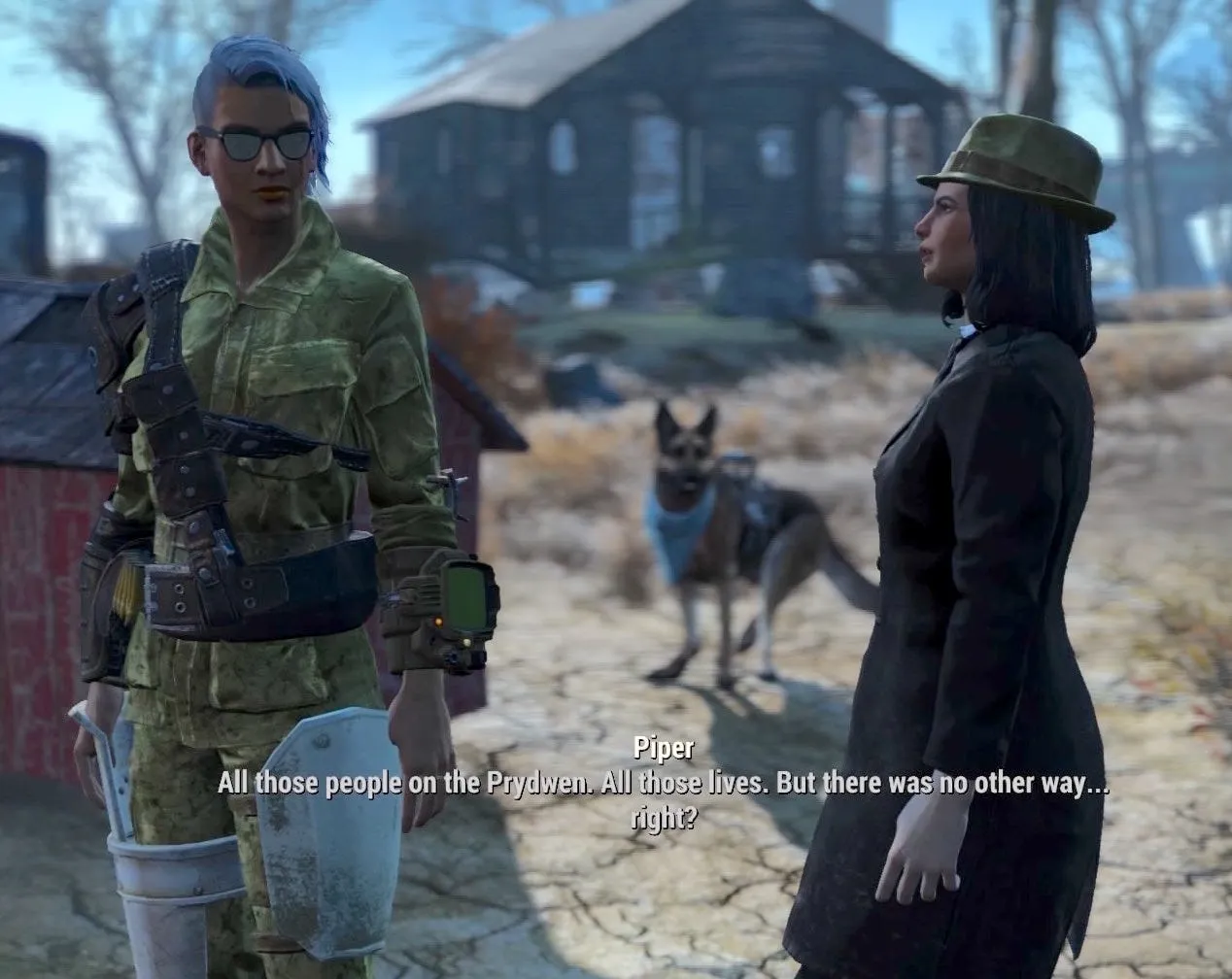
One minute I was trusted by every faction and the next minute I was detonating an airship, killing everyone on it, including many who had befriended me. (If you stop to ask your companions about the mission, most of them will say what you did was pretty terrible.) Then I went and did it again, on a grander scale, killing Institute civilians, unarmed scientists, and, for some reason, synthetic gorillas. I regretted every minute of that, but the game didn't let me turn back at that point, unless I quit and replayed.
Roger Ebert was often wrong when he dismissed videogames, but I saw him give a talk where he articulated a particular objection that stuck with me. He described an experimental movie (perhaps one of these?) in which the audience was allowed to choose from among several endings. He hated the experience. To him, multiple endings meant no final artistic statement; by saying everything, the filmmaker said nothing. He punished himself by compulsively watching them all. Ebert admitted that he was part of the problem — just knowing that other plot lines existed ruined his suspension of disbelief. He was driven to experience the work in its entirety, yet in doing so exposed how flimsily it was crafted.
Now I love games and I do think they can be art, but I also get where Ebert was coming from. I like branching storytelling, and I can hold in my head the somewhat contradictory notion that there is both a "real" plot (the one I experienced) and a multitude of potential others, the way scholars consider alternate or discarded drafts.
Nevertheless, I prefer to defend that suspension of disbelief, so I play most narrative games only once. Short of literal dead-ends, I don't revise my choices or try to optimize for the "best" ending. I make my bed and lie in it, as it were, because I find it gives the plot that fixity that Ebert craved.
I know from researching this article that there's a "better" ending for me, one I could've easily achieved if I'd just followed my instincts from the start. I could replay the game, and this time be honest with the Institute that I'm not going to follow their lead. I could work with the Minutemen instead, avoid detonating civilians, and betray nobody. It wouldn't be a solution without violence — it's a violent game and I like those fine — but the violence would be minimized. There's nothing wrong with starting over, as games are meant to be replayed and revisited, but it's just not how I play them.
"I thought about those works of Art that had moved me most deeply. I found most of them had one thing in common: Through them I was able to learn more about the experiences, thoughts and feelings of other people. My empathy was engaged. I could use such lessons to apply to myself and my relationships with others. They could instruct me about life, love, disease and death, principles and morality, humor and tragedy. They might make my life more deep, full and rewarding. [...]"
I had to be prepared to agree that gamers can have an experience that, for them, is Art. I don't know what they can learn about another human being that way, no matter how much they learn about Human Nature. I don't know if they can be inspired to transcend themselves. Perhaps they can. How can I say? — Ebert
Even with my mistakes, I got a pretty good ending. My fake son Shaun and my dog and my girlfriend are all happy. I tricked out my house in Sanctuary Hills and my townspeople have plenty of mutfruit and taters. I didn't turn fascist and I didn't promote slavery.
But there's a resident of my town who's missing because I killed her. I honestly didn't mean to. I thought of her as a game mechanic, a slot machine that opened up magical conversation options if I risked her health, and I kept pulling that lever. Eventually she died. I really wanted to restore and undo my action, but I didn't. Even though I brought clean water to Sanctuary and shored up our defense and defeated countless Raiders, I'm still constantly reminded by my neighbors that I "let Mama Murphy die." As they should.
Because if videogames are Art, and Art confronts us with the human condition, then we should be prepared to accept victory tarnished with regret. We can reflect on how violent acts obliterate good intentions. We can wish for second chances, just like in life, and opt to direct that impulse forward into our future decision-making. Heroes in Art can be deeply flawed, and a videogame is unique in making us complicit in those flaws if we let it, and don't undo.